
Hi, my name is Hudson. I used to guide a lot of walking tours in San Francisco, but this has primarily turned into a research and writing project over the years (which to be honest, is where it all started anyway). While a lot of my papers are published in The Argonaut these days, which is the journal of the San Francisco Historical Society, I still sporadically post stuff here that is pretty deep and primary researched, so if you have an interest in SF history, consider following this page (you can do so at the bottom-left below). Full disclosure: I am digitally lazy and am just using the last version of my tour site to continue on with this, if/when I do.
Since 2012, I have been working off-and-on on a history book with the working title, Fern Hill: The Lost History of San Francisco’s Nob Hill. From that project is where this site gets its name (see below for more on this). It was my growing interest in the earliest history of the neighborhood, while wandering around with my son, that inspired me to dig into what was out there, leading me to the realization that most everything out there today about Nob Hill’s earliest history was either unknown or bordering on nonsense and myth. Plus what I started to find was a unique lens into, or a microcosm of, Post-Gold Rush San Francisco–so while trying to maintain focus, the research has gone in all which ways. I did recently publish the first chapter (in 2025), so when that is available in PDF format, I will post it here.
If you have questions/comments please feel free to reach out to me at fernhilltours [at] gmail [dot] com.
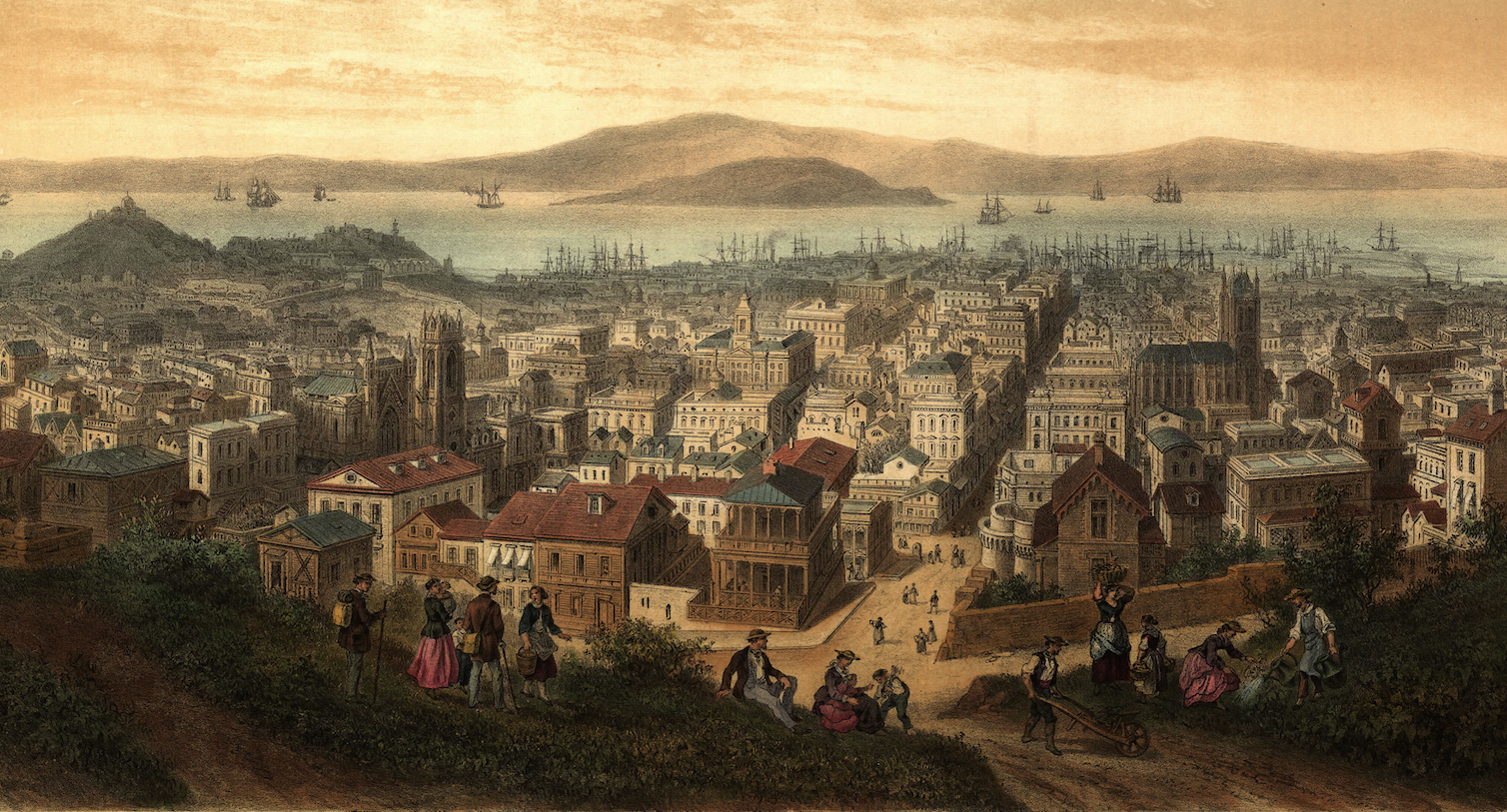
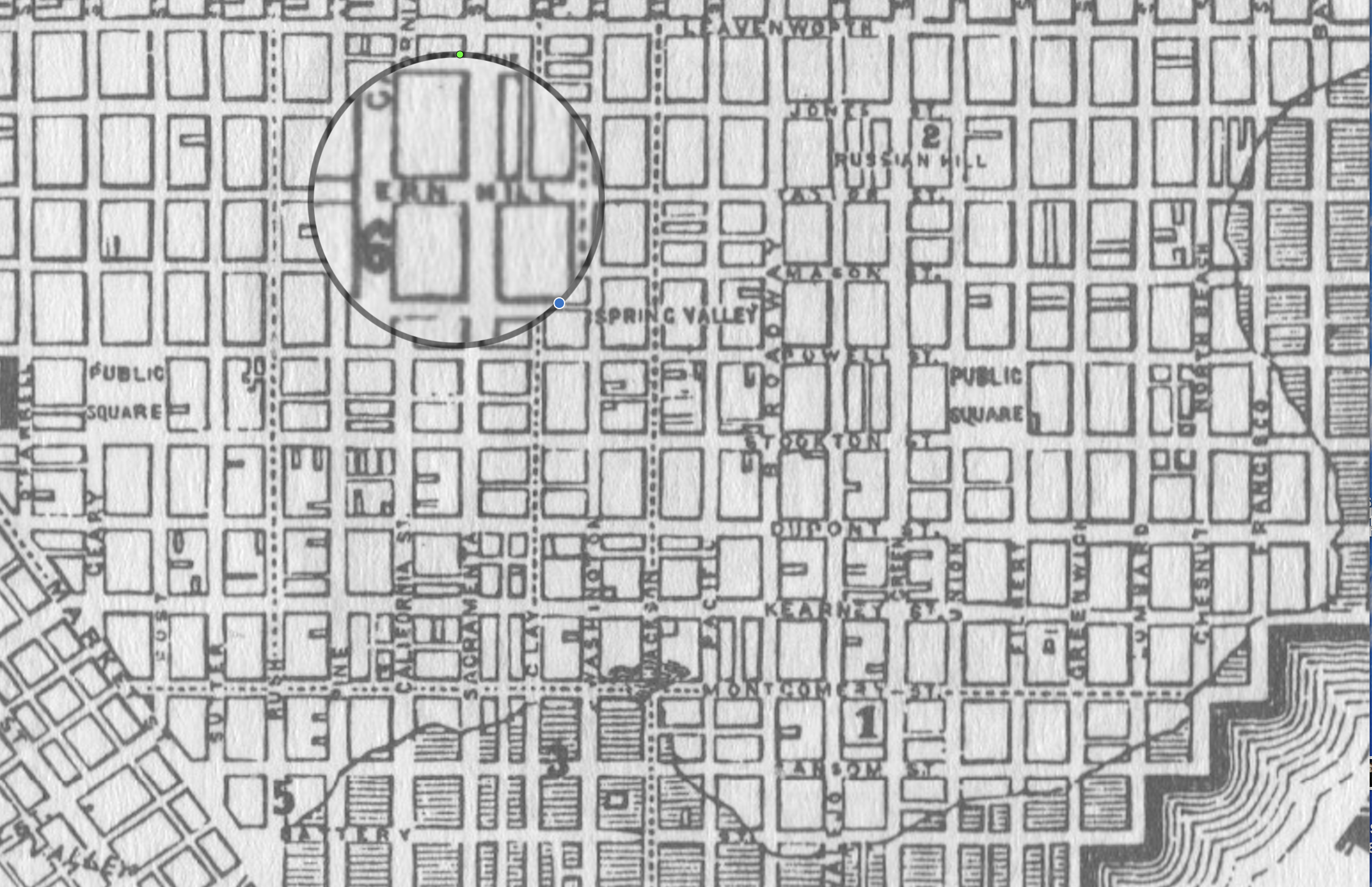
“Where is Fern Hill? I don’t see it on my map.”
Within The Annals of San Francisco–the first history book about San Francisco published in 1855 (out of NYC with offices in London and SF ready for distro)–Fern Hill was the name placed upon the map in its intro pages, specifically on Taylor between California and Sacramento streets, that is today’s Nob Hill. Note (if you look at the map below): the F-key was obviously challenged.
With the population explosion surrounding the California Gold Rush of 1849, not only did the “instant city” of San Francisco expand into and over the water, but also up hill to the west. That is, way before a cable car made it up the hill in the 1870s, which is what you may read in a lot of books on shelves today. In reality, the advent of the cable car became more about the development of Pacific Heights and areas west of Van Ness (then known as the Western Addition) than it was about the development of Nob Hill (though it wasn’t called that yet). I think the reason the cable car and Nob Hill got so historically enmeshed is not simply because the first cable car went up Clay Street in 1873, but because around the same time David Colton had built the first next-level house, that is, mansion–in 1871–on the south side of what is Huntington Park today (the Colton mansion was later owned by the Huntington family), which therefore ushered in the “Nob Hill” era, most likely coming from a derogatory term spoken condescendingly about those up on the hill building and living in said mansions. Keep in mind, these were the largest mansions being built throughout the world at the time, to my knowledge, and so for the next decade or so, at the heart of the Gilded Age, the neighborhood became internationally known.
The building of these mansions ultimately transformed a swath of the old Fern Hill neighborhood, therefore basically scraping the lots from Jones to Powell, between Sacramento and California. The last half-block to go was in the late-1880s, when James Flood bought the rest of the lots near the old Cushman property, leveled the block, and built the Brownstone, the outer of which remains today with Willis Polk’s added wings (today the Pacific-Union Club). The last full block was owned by James Fair, who died while planning his new home, and therefore his daughters built the Fairmont Hotel in his honor. Coincidentally, these last two structures were the only to survive the 1906 Earthquake and Fires. So today, they are the remnants of the “Nob Hill” era, 1971-1906, and right after . . . and into the neighborhood as it is today (much of which was built in the 1920s).
The focus of my book in-progress are the earliest settlers of today’s Nob Hill. The research has blown my mind many times, and therefore during the process, I chose to label the pre-Nob Hill era, that is the roughly 1852-1870 era of the hill “Fern Hill” after that early map name in The Annals of San Francisco. My assumption is that no one ever actually called the neighborhood Fern Hill (some then would have considered it the southern part of Russian Hill). It was most likely a name put on the Annals map by speculating real-estate men (see names at the begin of the book) who had helped develop the area with cottages all about. While indeed there were a lot of people living in the neighborhood by 1855, this book along with these plans, were also dropping at the onset of the Post-Gold Rush Depression.


Dear Mr. Bell: I would like to reach you to discuss a license to use a document. How do I contact you?
I can be reached here https://www.fernhilltours.com/contact Thank you.